Konuşmanın Türkçesini okumak için:
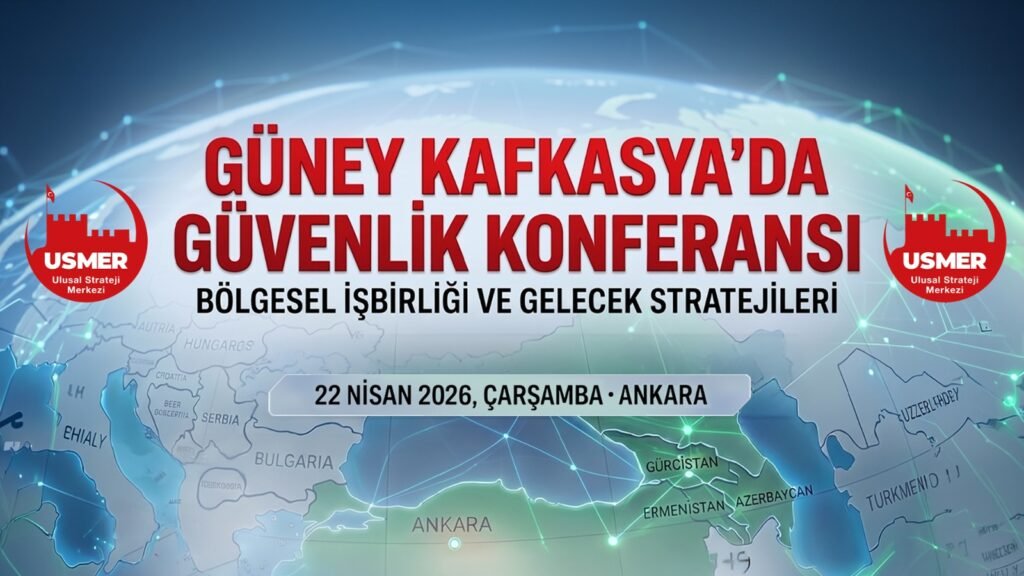
Ümit Yardım – Güney Kafkasya’da Güvenlik Konferansı Konuşması
The destruction experienced in recent times, particularly centered in the Middle East, makes it vital to reassess regional and global security issues across the world.
No region is free from similar threats or secure from them.
The South Caucasus today is one of the centers of geopolitical and global conflict.
The current international system has moved far away from the character of the post–World War II period and carries very radical differences.
The logic of the post–World War II era is insufficient today for a new world.
After the Cold War, efforts to establish a new regional/global order have remained inconclusive and have even brought about very new and serious threats.
The South Caucasus is among the foremost of these regions.
There are very significant political, military, and humanitarian problems. We are all aware of these.
Ideological, political, and theological debates at the global level can also be reflected in the region—such as liberalism, neoconservatism, and ideological exhaustion.
However, the fate of our region is not such. In the past, it has been able to become a center of civilization, life, and culture on a global scale.
The shared human and civilizational accumulation is an important force in the search for a new regional order.
Since the 1990s, the threats brought by the search for a new world have had their primary impact on this region.
Threat policies of regional countries against one another lead to seeking security from external actors and therefore make the intervention of third countries possible.
Unless the necessary bilateral and multilateral regional arrangements are realized, this characteristic will continue in the future.
Global developments may increase regional cooperation efforts. They may also serve as motivating factors. However, it is not possible for current developments alone to be sufficient for a new regional cooperation framework.
Essentially, there is a need for a search based on a visionary, not a reactionary, foundation.
The South Caucasus must be freed not only from the pressures and threats of external actors but also from the pressures and threats of relatively strong internal actors directed at smaller actors within the region.
The fundamental psychology of the regional future can be possible not on the basis of large–small state relations, but on the basis of relations among equal actors.
All calls and efforts for cooperation in this direction are valuable.
In the recent past, some of these include proposals such as the Caucasus Stability Pact and the “South Caucasus Home” proposed by Azerbaijani leader H.E. Mr. Ilham Aliyev in Tbilisi.
In addition, there are not only bilateral but also trilateral formats of relations and cooperation among regional countries. All of them are very important.
We are in one of the most favorable periods to think about, discuss, and take the necessary steps for a new South Caucasus. It is a difficult and threat-prone period, but we have no option other than struggle.
So, what should be done? The most famous question of all revolutionary and transitional periods.
There are enough problems, threats, and conflict areas before us for a new South Caucasus, and they can manifest themselves on various occasions.
However, it is important, at least, to consult and reach agreement on certain general principles.
These are not new, but they are especially more critical today.
****
SOME PRINCIPLES FOR A NEW SOUTH CAUCASUS
Determining Role; Intellectuals, public opinion, universities, media, and think tanks.
Action; Governments, determined political will.
Main Instruments; Strategic patience, determination, and modest gains. Shared past.
Rather than seeking a regional alliance at the initial stage, it may be emphasized that regional leaders come forward with declarations such as principles of a shared future.
Providing intellectuals, public opinion, and universities with a vision of work in this direction.
Method is as important as objectives.
Not an alliance or pact, but for example, a Forum.
Keeping distance from ideological approaches based on a culture of conflict.
Not security cooperation, but human and social cooperation should be prioritized.
Evaluating its future structure according to the progress achieved.
Benefiting from existing trilateral cooperation arrangements in the region.
For example, countries such as Azerbaijan and Türkiye have been able to turn their level of cooperation almost into a regional role model.
A stable Georgia also has the potential to be seen within this framework.
The participation of an Armenia that has resolved its problems with Azerbaijan and Türkiye would constitute a major step.
A new Caucasus cannot be built with intra-regional conflicts or frozen disputes.
In this regard, especially the resolution of the Karabakh issue is a historic step.
Constitutions and strategic documents must be cleansed of hostile, exclusionary, targeting, expansionist approaches toward regional countries, as well as those that see the region as a backyard, target regimes, or aim to create spheres of influence.
Every member of our region is valuable, important, and possesses a great historical and civilizational accumulation.
All of these are vital for the future South Caucasus Security Architecture.
The position of countries such as Russia and Iran has a unique nature. Strategic patience will be especially important in this dimension.
Each country has its own specific advantages. Their unique contributions to the process are important.
For example, Türkiye has a demographic base of 200 million at the global level. It is trying to develop relations and cooperation with Turkic countries.
Together with Azerbaijan, it has the capacity to extend the sphere of influence of a new Caucasus Vision to a wide geography.
Unfortunately, the approaches of powerful countries at both global and regional levels toward the region do not inspire confidence in certain respects. Filling this trust gap is a very important obstacle.
Major powers, in particular, must pursue a moral foreign policy.
The region needs the filling of this trust gap.
Respect for the sovereign equality of states, their territorial integrity, and their rights.
Refraining from the threat or use of force.
Inviolability of borders.
Respect for the political and military choices of states in their relations with the outside world.
Non-interference in internal affairs and electoral processes.
Peaceful resolution of regional and even global disputes and the contribution of regional countries to these processes.
Balanced approaches in areas such as security and development and relations with the outside world.
Respect for human rights and fundamental freedoms, including freedom of thought, conscience, religion, and belief.
These are essential not only for the international system but also for our new region.
International law seems to have lost its meaning in today’s global order.
However, the world does not possess any other legal instrument.
Therefore, can common approaches be developed in areas such as UN reform and the expansion of representation? Can efforts be made to expand regional representation in the UN Security Council?
Today’s wars, which are contrary to international law, have come to dominate our world.
The tragedy is that not only the attacked but also the attackers take refuge in the so-called principle of legitimacy. Article 51 of the UN Charter, the principle of self-defense, has become a victim of abuse.
One of the problematic areas is where the external diasporas of regional countries will stand within this vision of a new South Caucasus.
The new regional and global realities may not have been sufficiently comprehended by the overseas diasporas of the relevant countries.
These situations may hinder or block new regional initiatives.
Indeed, activities such as the Armenian Diaspora Action Conference held in Paris last week are far from the spirit of a new South Caucasus.
Regional countries must support their search for a new South Caucasus through effective and strong public diplomacy policies.
Determination based on strategic patience is important.
In the short term, there may not be strategic gains, but steps taken in this direction will certainly produce results in the medium and long term.